How Will the "Mother of All Deals" Impact the World Around Us?
Saksham Verma
Introduction to the trade deal
In Davos 2026, the EU and India signed a free trade deal. European Commission President Ursula von der Leyen described this as the “mother of all deals”, but is this really the case?
Figure 1: Chart of country GDP in proportion to the world
Source: The visual capitalist & IMF
As can be seen in the chart above, this ambitious deal by two economic power houses represents almost 25% of Global GDP, and impacts roughly two billion people. As both India and the EU strive to reduce or eliminate tariffs on almost every good traded, it is to be noted that the deal is still being reviewed by EU institutions and undergoing a legal vetting process in India, expected to be completed by the end of this year.
Why now?
Yet, despite the sheer magnitude of this deal, another piece of information is perhaps even more interesting - the timing. India and the EU have been undergoing negotiations since 2007 and have always been at a standstill due to regulatory standards, market access, and political disagreements. Hence, the fact that the deal came at a time of rising economic and geopolitical uncertainty, highlights the fragile situation of the world we currently live in (more specifically, the rise of protectionism in the US during the second Trump administration). With tariff uncertainty fueling geopolitics almost daily, the general view of the United States as a stable long term trading partner has reduced. This incentivizes both the EU and India to find other trading partners and diversify, which is a key proponent into why a deal that never happened for almost two decades just came to fruition.
However, this deal has a global impact beyond the two signatories. Other major global powers like China will face further trade diversion as EU and India trade relations grow stronger, all while the UK’s free trade deal with India in July of last year is now upstaged, and threatens their trade balance. Overall, this free trade agreement strengthens stability for the two economic blocks but otherwise showcases the fragmented global outlook the world faces today.
Impact of this deal on the EU
Looking through the specifics of this deal, the EU trade with India directly addresses the need for the EU to diversify its trading partners. Currently, a significant amount of the EU’s trade is concentrated with just three countries: the US, China and the UK (as shown in the chart below).
Figure 2: EU Trading Partners
Source: Eurostat
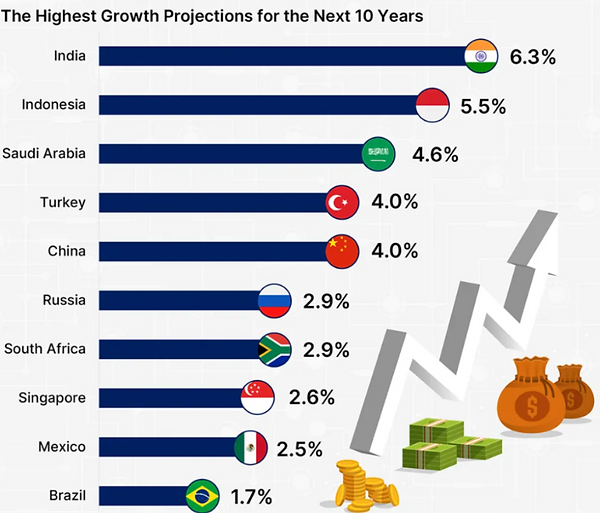
Given China's economic slowdown, and a Trump-led States not being a reliable trading partner, India’s predicted growth rise gives the EU access to one of the fastest growing large consumer markets in the world (as shown in the figure below).
Figure 3: Highest projected growth countries
Source: Straitsresearch
European manufacturers - particularly in automotive, machinery, chemicals and pharmaceuticals - stand to benefit most from the deal's tariff reductions. With India committing to reduce or eliminate tariffs on nearly 97% of goods over the next decade, one of the most significant shifts will be in the automotive sector, where India's historically prohibitive tariff rate of around 110% is set to drop to 40% immediately. This gives European carmakers a rare foothold in a long-protected market. Beyond manufacturing, EU firms in professional services, technology and education are also poised to gain from improved market access and closer regulatory cooperation.
Viewing this deal through a political lens, the deal reinforces the EU’s strategic autonomy, reducing its reliance on other global superpowers by strengthening ties with India. The deal also helps the EU with its ambition to position itself as a champion of free trade at a time when multilateralism is under strain.
Impact of this deal on India
It is worth noting that trade liberalisation inherently produces winners and losers. The gains European firms make in sectors where they gain greater access will come at a cost to Indian domestic producers, who will now face heightened competition and likely pressure on their revenues and profit margins. The same logic applies in reverse - in the sectors where India stands to benefit, it is European producers who will feel the competitive squeeze.
For India, the agreement delivers both immediate economic gains and longer-term strategic advantages. With the EU committing to reduce or eliminate tariffs on 99% of Indian goods over the next decade, the deal offers a timely counterweight to the damage inflicted by Trump's tariffs, which hit India's labour-intensive industries - textiles, apparel, leather goods, jewellery and footwear - particularly hard. Preferential access to one of the world's largest high-income consumer markets helps offset those losses and opens new avenues for export growth. Equally significant is the improved access to EU services markets, particularly in IT, professional services and education - areas that closely align with India's comparative advantages in skilled labour and human capital.
Moreover, beyond just the balance of trade, this deal is likely to increase European foreign direct investment (FDI) into India, supporting technology transfer and industrial upgrading. This FDI would build on from companies like Airbus, which sources over €1 billion annually in components and services from India and works with more than 100 Indian suppliers. Likewise, Siemens has also deepened its long‑term commitment to India through a €2.1 billion investment to gain an 18% stake in Siemens Ltd. With FDI already flowing to India from the EU in recent years, this FTA serves to accelerate this trend. This helps India’s development strategy of being further integrated in the global value and supply chains. As with the EU, India also has reduced dependency on specific trading partners like the US and China (as shown below).
Figure 4: India's Trading Partners
Source: Global Times
Politically, deeper alignment with the EU also helps India maintain its carefully balanced foreign policy and its overall strategic autonomy amidst the chaos in global trade today.
Conclusion
Overall, the EU–India free trade agreement is best characterised as a pragmatic response to a more uncertain and fragmented world economy. Economically, both parties can gain. Firstly, the EU secures access to a rapidly growing market while reducing dependence on volatile trading partners, and India benefits from expanded export opportunities, investment inflows and deeper integration into global value chains. However, these gains are likely to be uneven and almost impossible to predict the true benefits when accounting for adjustment costs, regulatory frictions and domestic political resistance likely to persist on both sides.
Geopolitically, the agreement signals a clear strengthening of EU–India relations. It serves as a trend and political shift towards large regional partnerships as substitutes for weakening multilateral institutions. While this deal does not yet constitute the emergence of a new global economic trading bloc, it does reflect a scenario where a convergence of common interests between two economic actors strive to seek greater strategic autonomy in an increasingly polarised world. The deal also has wider implications as major parties like China, the UK and the US, risk losing trade with its largest trade partners.
To conclude, it seems like the “mother of all deals” is as much a response to global disruption as to economic ambition. This deal is a great illustration on how trade is being reshaped, with countries striking more and more free trade agreements instead of multilateral trade that once dominated globalisation. For now, it seems like trade deals are being driven more for political necessity than the economic benefits it was once known for.
References
-
Airbus. 2024. “Airbus in India.” Airbus. August 6, 2024. https://www.airbus.com/en/about-us/our-worldwide-presence/airbus-in-asia-pacific/airbus-in-india.
-
Eurostat. 2024. “International Trade in Goods - Statistics Explained.” Ec.europa.eu. 2024. https://ec.europa.eu/eurostat/statistics-explained/index.php?title=International_trade_in_goods.
-
Feingold, Spencer, and Kate Whiting. 2026. “Here’s Why the India-EU Trade Pact Is the ‘Mother of All Deals.’” World Economic Forum. February 4, 2026. https://www.weforum.org/stories/2026/02/india-eu-mother-of-all-trade-deals-what-to-know/.
-
Maddela, Vidya Sagar. 2023. “Siemens Plans to Acquire 18% of Siemens India for €2.1bn.” NS Energy. November 15, 2023. https://www.nsenergybusiness.com/deals/siemens-to-acquire-18-stake-in-siemens-india/.
-
Rao, Pallavi. 2024. “The $115 Trillion World Economy in One Chart.” Visual Capitalist. December 19, 2024. https://www.visualcapitalist.com/the-115-trillion-world-economy-in-one-chart/.
-
Shah, Aditi, and Philip Blenkinsop. 2026. “Exclusive: India to Slash Tariffs on Cars to 40% in Trade Deal with EU, Sources Say.” Reuters, January 26, 2026. https://www.reuters.com/world/india/india-slash-tariffs-cars-40-trade-deal-with-eu-sources-say-2026-01-25/.
-
Straits Research. 2024. “The Top 10 Fastest-Growing Economies in the next Decade.” Straitsresearch.com. 2024. https://straitsresearch.com/statistic/fastest-growing-economies-in-the-next-decade.
-
“Top Trading Partners of India - Global Times.” 2025. Globaltimes.cn. 2025. https://www.globaltimes.cn/page/202508/1341325.shtml.
.png)