Has Economic Growth Reduced Inequality in the UK?
by Shreyas Veturi
Throughout modern history, economic growth has been treated as a one-size-fits-all solution to social problems. Yet, the relationship between economic growth and economic inequality remains deeply contested. Growth can reduce inequality by increasing employment and expanding fiscal capacity for income redistribution. Yet, it can also be argued that the benefits are unevenly distributed, disproportionately favouring higher-income demographics.
American economist Simon Kuznets formulated this tension by creating the Kuznets Curve, which depicts a bell-shaped relationship between economic growth and inequality. It suggests that income inequality rises during early industrialisation but declines as a country reaches a high-income, developed status. Here, we will assess whether the UK follows this association in recent history.
Using a time-series dataset from ‘Our World in Data’, the truth of this matter can be uncovered. Focusing on a single developed country, such as the UK, will allow for more data points to be examined without the confounding effects of cross-country institutional differences.
The Gini Index is used as the dependent variable to measure income inequality. The index ranges from 0 to 100, where 0 represents perfect equality and 100 represents maximum inequality. Using this measure allows us to assess inequality over time, which is ideal for analysing time-series data. The Gini index is chosen rather than the coefficient because the 0-100 scale avoids small decimal values when taking logarithms, thereby improving interpretability whilst preserving the same measure of inequality.
GDP per capita is used as the main explanatory variable because it is the standard measure of economic growth and the average level of economic output per person. As GDP per capita increases, the government may have a greater capacity to redistribute income through taxation and public spending.
The two control variables are chosen to isolate the effect of economic growth on inequality. The unemployment rate is used to capture labour market conditions, since higher unemployment could mean rising inequality, as there exists a widening income gap between those who are unemployed and employed. Government expenditure as a percentage of GDP captures the redistributive roles of government policy. This is because higher public spending through welfare, services and or transfers may reduce income inequality.
ln(GiniI)=α+β1ln(GDPpc)+β2Unemployment+β3GovExp+ε
Here, ln(GiniI) is the log of Gini index. ln(GDPpc) is the natural log of GDP per capita. The ‘Unemployment’ variable represents the unemployment rate. GovExp is government expenditure as % of GDP. ε is the error term. The estimated regression equation from the data is:
ln(GiniI)=5.6444−0.1747ln(GDPpc)−0.0061Unemployment−0.0109GovExp+ε
Both figures provide evidence to support the idea that economic growth reduces inequality. The coefficient for GDP per capita (β1 = -0.175) is statistically significant at the 5% level. This means that a 1% increase in GDP per capita is associated with a 0.175% decrease in the Gini Index, ceteris paribus.
Government expenditure (β3 = -0.0109) is also statistically significant at the 5% level. This means that higher public spending can be associated with lower inequality. But the coefficient for unemployment (-0.0061) is statistically insignificant, meaning this model does not suggest a clear relationship between unemployment and inequality.
The R square is 0.52. This means that around 52% of the variance can be explained endogenously.
At the surface level, these results are consistent with the later stage of the Kuznets curve for a developed economy like the UK. Higher income levels are indeed associated with lower levels of inequality. However, historically, this relationship has not been as clear-cut.
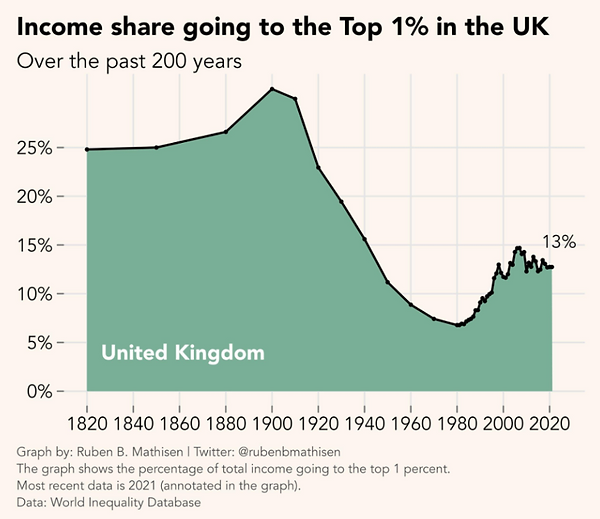
Instead of following a clear bell curve trajectory, inequality in Britain changed over the course of the 20th century in discrete phases. After peaking in the early 1900s, inequality sharply decreased and stayed mostly stable until the late 1970s. However, as income gains became more unevenly distributed during the 1980s, a time linked to Margaret Thatcher's economic reforms, they increased dramatically.
According to data from the Institute for Fiscal Studies, inequality in the UK increased significantly during this time before plateauing at historically high levels. Importantly, this rise in inequality coincided with ongoing economic expansion, casting doubt on the idea that growth by itself naturally lessens inequality.
This historical pattern is consistent with Thomas Piketty's criticism, which contends that extraordinary shocks like war and economic depression, rather than economic growth, were the cause of the mid-20th century declines in inequality. According to this perspective, institutions, policies, and historical context play a major role in determining inequality rather than it being self-correcting.
This interpretation is supported by the regression results. Although there is a negative correlation between GDP per capita and inequality, the effect is not very strong. Growth doesn't seem to be enough to cause significant redistribution on its own. Rather, the importance of government spending draws attention to a crucial realisation:
It is not growth itself, but how its gains are distributed, that determines inequality outcomes.
However, there are a few restrictions to be aware of. First, there is a chance for reverse causality: by decreasing consumption or escalating social instability, high inequality may itself impede economic growth. Second, wealth extremes, especially at the top of the income distribution, are not adequately represented by the Gini Index. Lastly, the long-term relationship may be distorted by significant structural changes, such as the Global Financial Crisis and post-Brexit adjustments.
In line with the later phases of the Kuznets hypothesis, economic growth in the UK is linked to slight decreases in income inequality. Growth, however, is by no means adequate. Rather, the results suggest a more complex conclusion: The conditions for lowering inequality are created by economic growth, but whether or not those gains are realised depends on policy.
References:
-
Our World in Data. 2024. “Income Inequality.”
https://ourworldindata.org/income-inequality -
Our World in Data. 2024. “Economic Growth.”
https://ourworldindata.org/economic-growth -
Simon Kuznets. 1955. “Economic Growth and Income Inequality.”
https://www.jstor.org/stable/1811581 -
Thomas Piketty. 2024. “Income Inequality Data (Piketty Series).” In Our World in Data.
https://ourworldindata.org/income-inequality#piketty-s-data -
Institute for Fiscal Studies. 2024. “Inequality.”
https://ifs.org.uk/inequality -
The Equality Trust. 2024. “How Has Inequality Changed?”
https://equalitytrust.org.uk/how-has-inequality-changed/ -
Our World in Data. 2024. “Top 1% Income Share in the UK.”