When Energy Becomes a Weapon
by Louis Fritsch
On 28 February 2026, the United States and Israel launched Operation Epic Fury, a coordinated strike campaign targeting Iranian leadership, military installations and nuclear infrastructure. Unable to match the United States and Israel in conventional military power, Iran turned to economic warfare. Its most potent tool: disrupting marine traffic through the Strait of Hormuz.
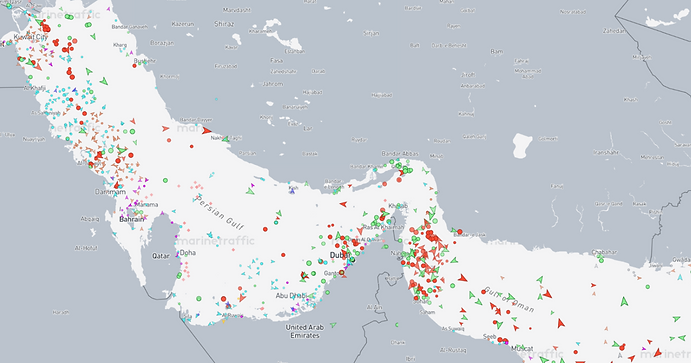
This narrow waterway between Iran and Oman, through which roughly 27% of the world's maritime trade in crude oil and petroleum products passes, is the primary marine export route for Gulf producers. Only Saudi Arabia and the UAE hold pipeline capacity capable of even partially circumventing it. On 4 March 2026, Iranian forces declared the Strait closed, backing their warning with direct attacks on vessels attempting to pass through it. Traffic through the strait has effectively come to a standstill since the war began, squeezing global supply and sending oil prices soaring.
Source: MarineTraffic (15/03/2026). The live traffic map indicates that no ships are currently transiting the Strait of Hormuz. A large number of vessels are waiting on either side.
As of the 15th of March at 13:00 GMT, Trading Economics data showed WTI crude trading at USD 98.71 per barrel and Brent crude at USD 103.14 per barrel. This represents increases of 58% and 50% in WTI and Brent prices respectively compared with the previous month, underscoring the scale of the economic disruption. Such increases pose a risk to the global economy. Higher energy prices raise transport and production costs, thereby fuelling inflationary pressures and weakening growth.
In his first public statement, Iran’s new Supreme Leader (Mojtaba Khamenei) vowed to use “the lever of blocking the Strait of Hormuz”. The objective is clear: by wreaking havoc on the global economy, Tehran hopes to pressure the United States and Israel into ending the offensive.
Iran’s use of the strait as an instrument of economic coercion is not without precedent. States have repeatedly weaponised energy flows, using control over strategic chokepoints, supply routes, and market access to extract political concessions by imposing economic costs. Crucially, this is not a tactic employed only by those under attack.
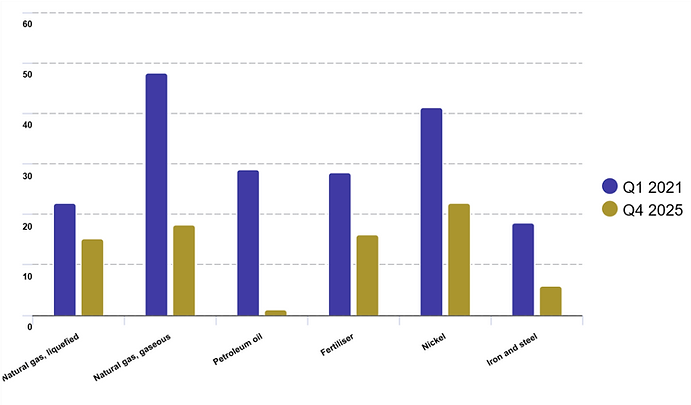
The EU's response to Russia's invasion of Ukraine in 2022 is instructive. Before the war, the bloc imported 155 billion cubic metres of Russian gas annually (around 45% of its total gas supply). This dependence extended across a broader range of energy commodities. In response to the war, the EU pursued two parallel objectives: reducing its own structural exposure to Russian energy and cutting off the revenues sustaining Moscow's war effort. It pursued both through successive sanctions on Russian coal, oil and LNG, combined with an accelerated diversification of supply. The data below shows that the diversification element of this strategy has been successful:
Source: Eurostat. Each bar shows the share of EU imports of a given product coming from Russia, comparing the first quarter of 2021 with the fourth quarter of 2025.
However, diversification of supply away from Russian imports has not in itself been what has dented the revenues sustaining Moscow's war effort. Russia has largely offset lost Western demand by redirecting exports to Turkey, China and India. Crude export volumes remain 6% above pre-invasion levels at 215 million tonnes.
The Centre for Research on Energy and Clean Air (CREA) found that Russia's total fossil fuel export revenues (covering oil, gas, coal and refined products) totalled €193 billion in the 12-month period to February 2026, down 27% from the comparable pre-invasion period. That decline is the result not of lost volume but of the price caps imposed by the EU in cooperation with the G7, which have forced Moscow to sell at a discount to the buyers it can find.
Across both cases, a common logic emerges: states reach for the weaponisation of energy flows when direct confrontation is either impossible or too costly. For Iran, coercion through the chokepoint of the Strait of Hormuz offers leverage against adversaries it cannot confront militarily. For the West, sanctions offer a way of imposing real costs on Moscow while avoiding the escalatory risks that direct intervention in Ukraine would have carried. In each case, energy becomes a substitute for force.
Regardless of the strategic rationale, the costs are ultimately borne by consumers. When energy is weaponised, the economic shock does not stop at the government or the trading desk but passes through to households via energy bills and to the wider economy as businesses facing higher input costs push prices up. Although it is too early to assess the full ramifications of the current conflict in the Middle East, the Russia case offers an instructive baseline.
Diversification away from Russian supply required the EU to secure alternative sources in an already constrained market, thereby intensifying competition for available volumes and contributing to higher energy prices. The data below illustrates the burden borne by EU consumers as a result of the conflict:
Source: Eurostat, via Euronews. The dashed line marks the start of the war, while the plotted lines show the price, in euros, per 100 kWh. After an initial surge, energy prices have yet to return to pre-war levels.
Annual inflation in the EU reached 9.2% in 2022 (the highest level ever measured) as the energy shock fed into broader inflationary pressures. The current crisis in the Middle East has revived concerns that a similar inflationary dynamic may re-emerge. For example, expectations of renewed price pressures have already led markets to scale back hopes of a Bank of England rate cut.
To conclude, the latest escalation marks a renewed instance of energy being weaponised for political ends. The central question is how long can the blockade last. With the midterms approaching, Trump and the Republicans have a strong incentive to avoid prolonged economic disruption. Should the blockade continue to drive up global energy prices and inflationary pressure, Washington may find itself compelled to curb military operations and settle for a compromise short of its original aims.
A note to the reader: this article was written in March 2025. Subsequent developments may have altered some of the data, context, or arguments presented.
References:
-
Abnett, Kate. 2026. “Four Years into War, Russia’s Energy Revenues Drop but Oil Keeps Flowing.” Reuters. February 24, 2026. https://www.reuters.com/sustainability/boards-policy-regulation/four-years-into-war-russias-energy-revenues-drop-oil-keeps-flowing-2026-02-24/.
-
“Crude Oil.” n.d. Trading Economics. https://tradingeconomics.com/commodity/crude-oil.
-
“EU Trade with Russia - Latest Developments.” 2025. Eurostat. https://ec.europa.eu/eurostat/statistics-explained/index.php?title=EU_trade_with_Russia_-_latest_developments.
-
“Iran Conflict and the Strait of Hormuz: Impacts on Oil, Gas, and Other Commodities.” 2026. CONGRESS.GOV. Congressional Research Service. https://www.congress.gov/crs-product/R45281.
-
Ittimani, Luca. 2026. “Why Has the Iran War Sparked Fears of Stagflation for the Global Economy?” The Guardian. March 10, 2026. https://www.theguardian.com/business/2026/mar/09/iran-war-oil-prices-stagflation-global-economy.
-
Kardás, Szymon. 2023. “Conscious Uncoupling: Europeans’ Russian Gas Challenge in 2023.” European Council on Foreign Relations. February 13, 2023. https://ecfr.eu/article/conscious-uncoupling-europeans-russian-gas-challenge-in-2023/.
-
Pomeroy, Gabriela. 2026. “Iran’s New Supreme Leader Vows to Block Strait of Hormuz in First Statement.” BBC. March 12, 2026. https://www.bbc.com/news/articles/cdxg599655vo.
-
“The Strait of Hormuz Is the World’s Most Important Oil Transit Chokepoint.” 2023. U.S. Energy Information Administration. November 23, 2023. https://www.eia.gov/todayinenergy/detail.php?id=61002.
-
Yanatma, Servet. 2026. “Four Years after Russia’s Invasion: How Have Electricity and Gas Prices Changed across Europe?” Euronews. February 26, 2026. https://www.euronews.com/business/2026/02/26/four-years-after-russias-invasion-how-have-electricity-and-gas-prices-changed-across-europ.