What are stabilising factors behind Hong Kong’s currency peg?
by Alisa Gao
Introduction and Institutional Background
Hong Kong’s Linked Exchange Rate System (LERS) has been one of the world’s longest-lasting fixed exchange rate regimes. Following periods under the silver standard, a sterling peg and floating exchange rate system, Hong Kong adopted a currency board system linked with the U.S. dollar (USD) in 1983 to defend against the rapid depreciation caused by political uncertainty during the Sino-British negotiations (1). Despite repeated bets from hedge fund speculators on its collapse, the system has endured and its credibility remains strong (2). This article aims to investigate the stabilising factors that have kept the Hong Kong dollar (HKD) within a narrow band of 7.75-7.85 HKD per USD in recent decades.
A paper from the Hong Kong Institute for Monetary Research (HKIMR) highlights a key feature of Hong Kong currency board system: the Monetary Base is fully backed by foreign reserves, strengthening the sustainability of the peg against external pressures. Under this framework, the Hong Kong Monetary Authority (HKMA) only extends loans to the government and banks when the lending is secured by foreign assets (3).
Drawing a parallel from history, the collapse of the Gold Standard collapsed because of a liquidity mismatch - the global supply of US dollars exceeded available gold reserves (4). Hong Kong avoids this historical trap by design. By mandating a 1:1 foreign reserve backing for the entire monetary base, the Currency Board system creates a binding constraint on monetary expansion. This is not just a policy preference; it is a structural guarantee of the peg’s sustainability, further anchored by Hong Kong’s consistent current account surpluses (5).
Empirical Model Specification
To investigate the stabilising factors behind the HKD’s peg, it is necessary to examine the interaction between HKMA policy actions and exchange rate market dynamics. The empirical model captures both HKMA’s intervention and profit-seeking behaviour of market participants by including the logarithm of Aggregate Balance and the interest rate differential as independent variables.
The Aggregate Balance (AB) is the total clearing amount by banks held at the HKMA and forms part of the monetary base. The HKMA influences liquidity conditions in the banking system by adjusting the Aggregate Balance through open market operations - buying or selling HKD against USD.
The interest rate differential captures the relative return between U.S. dollar and Hong Kong dollar assets. The 1-month Hong Kong Interbank Offered Rate (HIBOR) is used as a proxy for Hong Kong interest rates while the U.S. rates are proxied by 1-month LIBOR in the earlier period and 1-month SOFR from 2019 onwards. The data set spans from June 2025 - when the HKMA introduced the convertibility band of 7.75-7.85 HKD per USD - to February 2026.
Baseline Result (2005-2026)
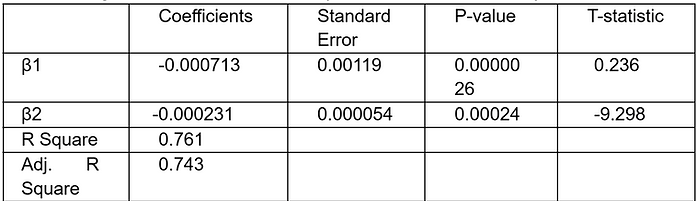
Table 1. Regression Result between June 2005 and February 2026
Observations = 249
The highly significant coefficient on the interest rate differential (β2) supports the theoretical expectation: a widening differential incentivises investors to shift into higher-yielding U.S. dollar assets, generating depreciation pressure on the HKD against USD.
However, the coefficient on Aggregate Balance remains statistically insignificant (p>0.05) in the full sample. A closer inspection of the data suggests that this may reflect the relative stability of the Aggregate Balance during the early years of the sample. Between 2005 and 2007, the HKMA rarely intervened through liquidity adjustments.
Crisis and Post-Crisis Dynamics (2007-2026)
Table 2. Regression Result between September 2007 and January 2010
Observations = 29
During the period from September 2007 to January 2010, which coincides with the global financial crisis, the explanatory power of the model increases substantially. Notably, the coefficient on Aggregate Balance becomes statistically significant and changes sign, which may seem to lack theory-proving in the first glance.
In theory, an increase in the Aggregate Balance injects liquidity to the banking system, lowers the interbank interest rate, and exerts depreciation pressure on HKD through capital outflows.
However, this result is consistent with the operational mechanism of the currency board system. Under the Linked Exchange Rate System, adjustments in Aggregate Balance are often endogenous responses to exchange rate pressures, introducing reverse causality into the regression model.
Amid the U.S. sub-prime mortgage crisis, heightened risk aversion led to capital inflows into safe-haven assets, placing appreciation pressure on the HKD. In response, the HKMA increased the Aggregate Balance, allowing market forces to adjust in accordance (6). The negative coefficient therefore reflects an endogenous policy response rather than a direct causal relationship.
Table 3. Regression Result between January 2010 and February 2026
When extending the analysis to the post-crisis period (January 2010 to February 2026), the coefficient on Aggregate Balance remains negative and statistically significant, with an adjusted R of 0.470. This suggests that HKMA has continued to respond systematically to exchange rate pressures beyond the crisis period.
Evaluation
However, HIBOR and Aggregate Balance tend to move together - a rise in Aggregate Balance injects liquidity by lowering HIBOR, revealing a risk of multicollinearity. High condition numbers in the model (ranging from 449 to 1200) confirm this overlap. This makes it difficult for the model to isolate the impact of each variable.
In addition, existing literature highlights the influence of China’s onshore and offshore exchange rate on HKD, that the depreciation in Chinese currency may weaken confidence in Hong Kong’s currency board system, raising concerns about the durability of the peg (7).
Conclusion
The article finds that while interest rate differentials drive short-term exchange rate through capital flows, the Aggregate Balance mainly reflects the HKMA’s active open market participation rather than an independent causal factor. During periods of financial stress, adjustments in the Aggregate Balance help accommodate capital flows and stabilise the exchange rate within the convertibility band. Overall, the sustainability of the HKD peg is underpinned by strong institutional credibility, full reserve backing, and rule-based policy discipline, although external risks - particularly from mainland China and global financial conditions - remain.
References:
-
Rognes, Asa Malmstrom, and Catherine R. Schenk. “One Country, Two Currencies: The Adoption of the Hong Kong Currency Board, 1983.” The Economic History Review 76, no. 2 (October 12, 2022). https://doi.org/10.1111/ehr.13211.
-
Ashworth, Louis. “Barclays: The Pegging Will Continue.” @FinancialTimes. Financial Times, December 8, 2022. https://www.ft.com/content/d65dfc2d-f045-40cb-9fe0-33656806cad6.
-
Latter, Tony. “Rules versus Discretion in Managing the Hong Kong Dollar, 1983-2006.” SSRN Electronic Journal, 2007. https://doi.org/10.2139/ssrn.1007159.
-
Bordo, Michael D., Owen Humpage, and Anna J. Schwartz. “U.S. Intervention during the Bretton Wood Era: 1962-1973.” SSRN Electronic Journal, 2011. https://doi.org/10.2139/ssrn.1807117.
-
International Monetary Fund. Asia and Pacific Dept. “People’s Republic of China—Hong Kong Special Administrative Region.” IMF Country Report 2023, no. 186 (May 1, 2023): 1–1. https://doi.org/10.5089/9798400243905.002.
-
Hong Kong Monetary Authority. “Monetary Stability.” Accessed March 17, 2026. https://www.hkma.gov.hk/media/eng/publication-and-research/annual-report/2007/11_monetary.pdf?.
-
Jermann, Urban, Bin Wei, and Vivian Yue. “How Credible Is Hong Kong’s Currency Peg?,” September 1, 2025. https://doi.org/10.3386/w34300.